Natural Stacks Review: The Nootropic Brand That Shows Its Homework
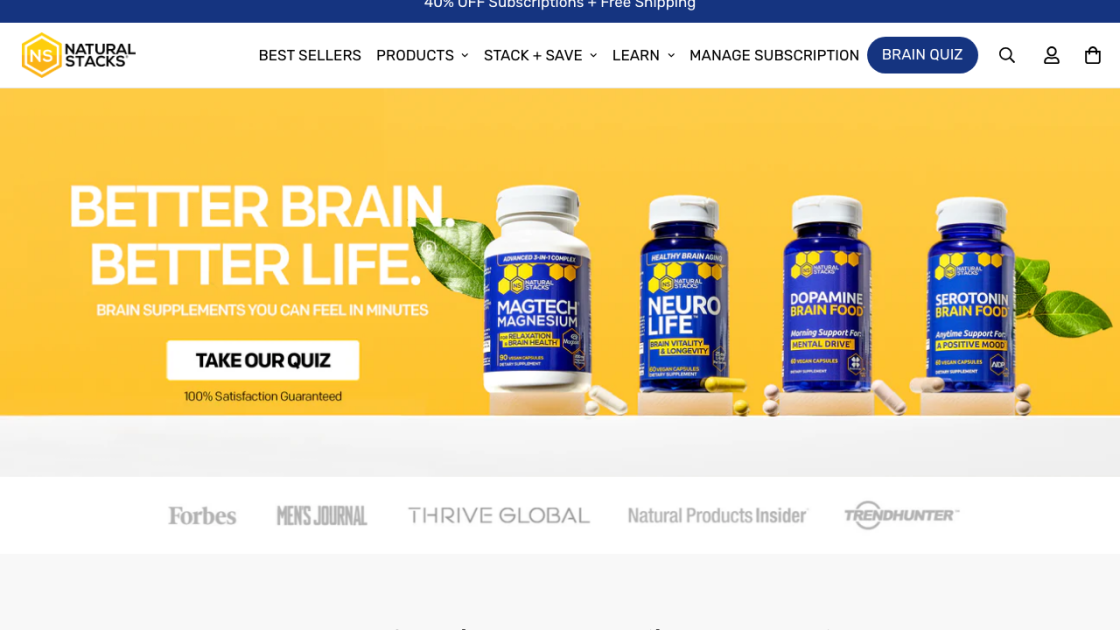
The supplement industry has a transparency problem it has never had a good excuse for. Proprietary blends let a brand list impressive ingredients while concealing how much of each is actually present — which means a formula can look identical to a research-backed dose while containing a fraction of it. Natural Stacks made refusing that practice its entire identity, publishing full label disclosure and describing the approach as ‘open-source’.
What the brand sells
Targeted formulas rather than a general ‘brain health’ pitch:
- MagTech® Magnesium — sleep and relaxation
- Dopamine Brain Food™ — drive and motivation
- NEUROFUEL™ — focus and memory
- Serotonin Brain Food™ — mood
- NeuroLife™ — cognitive aging
Capsules, drinks, gummies and chewable bites, priced roughly $13.56 to $54.33 with subscription savings advertised up to 40%.
Why disclosure is the feature
With a proprietary blend you learn the total weight of a mixture, never the individual doses. That makes comparison against published research impossible and enables the practice sometimes called fairy-dusting — a trace of a recognized ingredient earning a place on the front of the box. Full disclosure lets you do the arithmetic yourself before you buy, which is the position every informed buyer should insist on.
The related choice — 4-5 key ingredients per product instead of the 10-15 common elsewhere — makes the labels readable rather than decorative. Fewer ingredients at meaningful doses is almost always a better formulation strategy than many at token ones.
The product with the strongest science
MagTech is where we would start. Magnesium contributes to normal muscle and nerve function and to psychological function, and the National Institutes of Health notes that many US adults fall short of recommended intake through diet alone — adult targets generally sit around 310-420mg daily depending on age and sex. A common shortfall with an inexpensive, well-tolerated fix is a far better starting point than an exotic compound with a thin evidence base.
Setting expectations honestly
The realistic ceiling for a well-made nootropic is a modest, sometimes noticeable improvement in focus, mood or sleep quality. It is not transformation, and any brand promising that is selling something other than science. The interventions with the largest documented effect on cognition remain unglamorous: the National Sleep Foundation recommends 7-9 hours of sleep for adults, and the WHO recommends at least 150 minutes of moderate activity per week — both do more for mental performance than anything in a capsule.
Natural Stacks markets some products as producing results on the first dose rather than after a loading period. That is plausible for acute-acting ingredients, less so for compounds working through neurotransmitter synthesis. Treat it as product-specific and judge by your own notes.
How to test one properly
- Buy one product tied to one specific complaint.
- Fix sleep, caffeine timing, protein and exercise first — they dominate the outcome.
- Compare the disclosed doses to published ranges. Transparency is only useful if you use it.
- Keep a daily note for two weeks; cognitive effects are subtle and memory is unreliable.
- Change one variable at a time or you will never know what worked.
Safety notes
Dietary supplements are not evaluated by the FDA to diagnose, treat, cure or prevent disease. Speak with a healthcare provider before starting anything new if you are pregnant, nursing, taking prescription medication, or managing a health condition — formulas that influence neurotransmitter pathways warrant particular caution alongside antidepressants, stimulants or blood-pressure medication. Individual response to cognitive supplements varies widely, and what works noticeably for one person may do nothing for another. This review is information, not medical advice.
Pros and cons
Strengths
- Full label disclosure with ingredient traceability
- Focused 4-5 ingredient formulas
- Products mapped to specific functions rather than vague claims
- Lab tested for purity and potency
- Multiple formats and meaningful subscription savings
Limitations
- Premium pricing versus buying single ingredients
- Evidence quality varies sharply by compound
- ‘First dose’ claims are not universal
- Response varies considerably between individuals
Final word
Natural Stacks wins on the one dimension a buyer can actually verify: it tells you exactly what is in the bottle and how much. In a category built on opacity, that alone deserves attention. Start with magnesium, where the science is firmest, measure honestly over a fortnight, and treat any cognitive supplement as a small edge layered on sleep and exercise rather than a replacement for them.
The hierarchy of things that actually improve cognition
Any honest nootropic review has to place supplements in their proper position, which is near the bottom of a well-established hierarchy. Sleep sits at the top: research on sleep restriction consistently shows measurable declines in attention and working memory well before people subjectively notice impairment, which is why the National Sleep Foundation’s 7-9 hour guidance matters more than any capsule. Aerobic exercise is second, with the WHO recommending at least 150 minutes of moderate activity weekly for adults.
Nutrition, hydration, caffeine timing and stress management occupy the middle. Supplements come after all of it. That is not an argument against buying them — it is an argument for buying them in the right order, once the larger levers are already pulled. A disclosed-label product simply lets you evaluate whether the marginal gain has any chance of materializing before you pay for it, which is more than most of the category offers.
What a fair two-week trial looks like
Cognitive effects are subtle enough that impressions are close to worthless, which is why a structured trial beats a vague sense of whether something ‘worked’. Pick two or three measures you can rate daily in under a minute — time to fall asleep, afternoon focus, mood steadiness — and score each from one to five at the same time every day.
Keep everything else as constant as you can for the fortnight: same caffeine timing, same rough bedtime, no new supplements alongside it. At the end, compare the second week against the first. If the difference is not visible in the numbers you recorded, it probably is not there — and that is a genuinely useful result, because it saves you a subscription.
Frequently asked questions
What does ‘open-source’ mean here?
Full label disclosure — every ingredient and its exact dose published, rather than hidden in a proprietary blend.
What do the products cost?
Roughly $13.56 to $54.33, with subscription discounts advertised up to 40%.
Where should I start?
MagTech magnesium — dietary shortfalls are common, the ingredient is well characterized, and it is the most defensible purchase in the range.
Do nootropics really work?
Effects are generally modest and vary by compound and individual. Sleep and exercise remain the largest levers on cognition.
Can I take them with medication?
Check with your healthcare provider first, especially alongside antidepressants, stimulants or blood-pressure medication.
Affiliate & medical disclosure: This review is independent and for information only, not medical advice. Some links may be affiliate links; we may earn a commission at no cost to you, which never affects our score. Consult a licensed provider before starting any product.